Yale School of Management United States
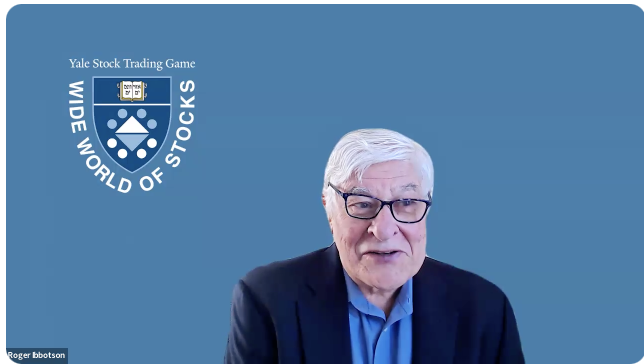
Every year since 2021, students from across the Global Network for Advanced Management have gathered virtually to play the Yale Stock Market Trading Game, a simulation created by Roger Ibbotson, professor in the practice emeritus of finance at Yale SOM. The latest edition of the competition concluded this week with a resounding victory by Laurin Komar, a master’s in finance candidate at Bocconi University.
At an online closing ceremony on February 24, Ibbotson noted that he had created the original version of the Stock Market Trading Game—played in person with paper cards—more than 50 years ago.
“My general view on education,” he said, “is the more we can get people to actually participate and do things, that’s how people actually learn. You can’t just learn by reading articles. You actually have to do things to learn. And in this case, that’s learning about markets.”
Jaan Elias, SOM’s director of case research and development, explained that this year’s competition happened to simulate the challenges of a market downturn. “We have never seen a bear market like this before,” he said. “Very hard to trade in it. Two of the [four simulated] companies were actually worthless. I should emphasize: We didn’t do this on purpose. This is all randomly chosen. When the game starts, the computer randomly chooses the cards for every company.”
With the market dropping 58% over the course of the game, only four of the players ended with positive returns, including Komar, whose strategy of buying private information, trading bid-ask spreads, and aggressively short-selling earned a 31% return for the largest margin of victory in the game’s history.
The results, Ibbotson said, underscore a central lesson of the game.
“When the market is down, we all think we’re fools, and when it’s up, we all think we’re geniuses,” he said. “What really matters is whether you beat the market. You can’t control the market—the best you can do is try to outperform it.”